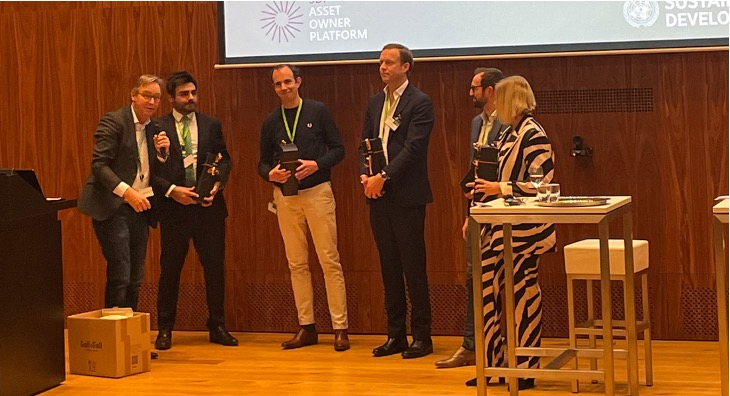
Summary SDI AOP seminar hosted by PGGM
After the inaugural roundtable PGGM hosted in March 2022, we reconvened February 9th in Zeist again in what is becoming an annual tradition. Participation doubled versus last year, with 60 people joining the event. It was a lively seminar with a lot of interaction with the audience.
Jaap van Dam of PGGM, who is one of the Design Authority members of the SDI AOP opened the seminar. The meeting kicked off with a short introduction by Hans Op ‘t Veld, the chair of the Markets & Members committee. He gave a short recap of the SDI AOP progress and activities over the last year. It has been a year of growth for the SDI AOP, both in terms of the innovations that have been implemented as well as with the growth of the user base.
On the back of the conversation with the user base the innovations have included both the coverage universe, the type of data offered and the user interface. As for coverage, the user base have helped us to determine in which order we should extend the universe of the SDI AOP classification. Throughout 2022, the equity and fixed income universes have both grown and in the first quarter of this year there will be another addition in the emerging market fixed income space. Importantly, the collaborative spirit of the platform has been reinforced through events like roundtables and seminars, but also through the establishment of a User Advisory Group that convenes every quarter. The User Advisory Group has thus become an important way of the platform to determine what the priorities should be in developing out further innovation and tooling.
In the following session, SDI AOP Research Director James Leaton elaborated on some of the development work that has gone on in the platform Hans alluded to. He was joined on stage by Nico Langedijk from Qontigo and Pieter Laurens Baljon who is with Entis. One wish that was high on the list from the users of the data was the ability to generate reports and have information on the level of the investment portfolio of users. This wish has turned into what has been called the ‘dashboarding project’ within the platform. The SDI AOP have worked with Qontigo to build a user interface that allows users to extract information in a way that is conducive to reporting and to allow people to generate overviews on the SDI content of their holdings. During the session a number of mock-ups were shared and the platform announced that the dashboarding functionality will now become part of the tooling offered to the users.
Besides the dashboarding, James introduced the SDI Innovation Outlook, which was launched at the PRI in person meeting in Barcelona last December. Pieter Laurens took the audience through the methodology behind the Innovation Outlook, which can be used to gauge to what extent companies are investing in technologies that could generate new products contributing to the SDGs. There is a multitude of applications and use cases that could be supported by this data. Various uses were discussed, including the ability to use the data to predict future revenues, the support of engagement and potential alpha generating capabilities in an ordinary investment sense. Nico talked the audience through the work that Qontigo have done using the Innovation Outlook to look at the ability of the data to generate financial outperformance. Some of the work indicates that there is valuable information in the data, even when controlling for some key risk factors, including geography and sector, but also looking at style factors. The paper is available for access at the Qontigo website here. The conversation prompted a number of questions from the audience, as the data provides opportunities to further look into the business models of companies. From a research angle, there also is a lot of information in the innovation outlook to review.
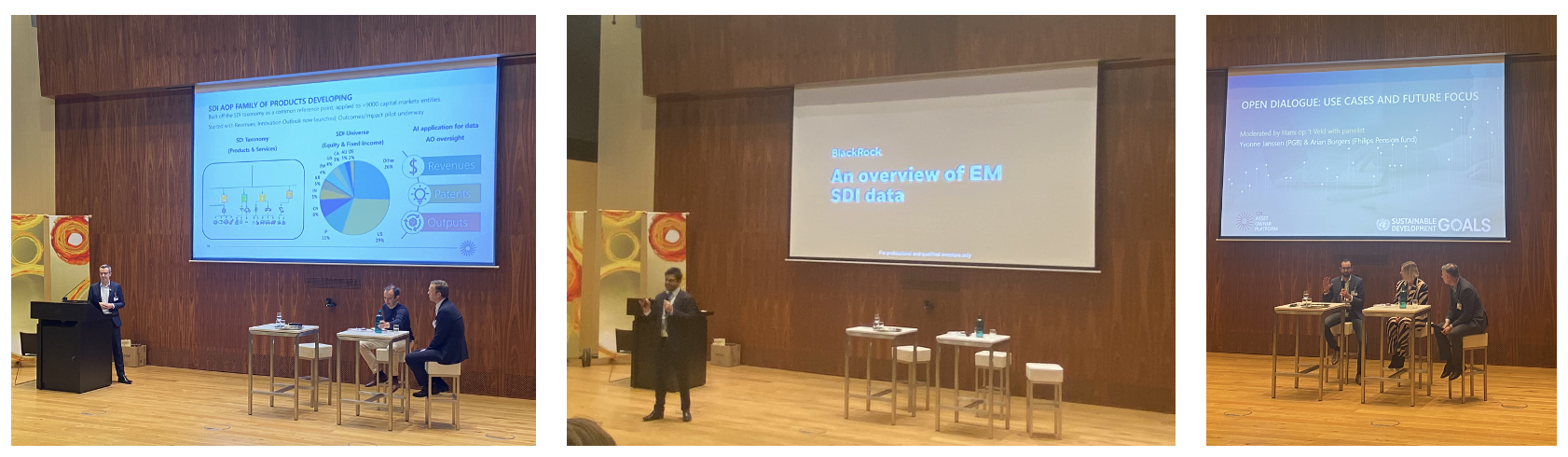
In the session after James’s presentation, Muhammed Masood of Blackrock discussed one of the aspects new to the SDI AOP data: emerging markets. The SDI AOP has added substantial coverage on these markets after the initial push in developed markets and is now seeing keen interest in this data. One of the key questions he looked at is the makeup of that data and whether there are major differences between the developed and emerging markets classifications. Even though the amount of SDI contribution found by number of companies in emerging markets appears to be rather similar to the developed markets series, there are some noticeable differences. One of those pertains to the confidence scores – which are in short the indicators of the level of certainty with which the SDI percentage could be ascertained. Whereas the developed markets data shows that in most the majority of the data has high confidence levels, this is less true for emerging markets data. However, when looking at the confidence for decisive and majority SDI, the confidence levels of emerging markets companies are more akin to those in developed markets. While it suggests that the reliability of the SDI AOP data in emerging markets is as good as in developed markets, it also points out that there is room for improvement in revenue information in emerging markets. Looking at individual sectors and countries, Muhammed presented some interesting findings on the distribution of SDI. As expected, some sectors offer more exposure to SDI than others. However, it is also quite informative to gauge to what extent SDI as well as non-SDI form part of a sector. If both categories exist within the same sector, it is possible to improve the SDI exposure within a particular sector while leaving the sector weight untouched. If there is only one category present, this opportunity does not exist. The same principle holds true for countries and the way in which these are allocated over in a portfolio.
Separately, Muhammed compared the SDG exposures in emerging and developed markets and the relationship between SDI and carbon reduction targets. The conclusion is that in broad terms, the exposures to individual SDGs are pretty similar, although in some cases the order may differ. Particularly SDG 3 and 7 stand out as having the largest frequencies. As for carbon reduction, SDI are more likely to provide targets on carbon reduction, whereas 38% of non-SDI do not provide a target.
In the last session, two user of the data reflected on SDI AOP use cases and the requirements going forward. In a small panel moderated by Hans, Yvonne Janssen of PGB and Arian Borgers of Philips Pension Fund shared their views. Yvonne explained that PGB with its beneficiaries with different backgrounds have embarked on an investment strategy that encompasses all SDGs. Besides the different stakeholder preferences, the fact that SDGs are (by design) connected to one another and all have a positive influence has prompted the approach to look at investment into the SDGs. Arian explained that Philips Pensioenfonds caters to the Dutch employees of Philips and Signify, which is (with some differences) a more homogeneous constituency. Philips has held a stakeholder survey, which led to the selection of four SDGs to focus on. Within the wider seminar audience, both approaches are also being applied. Philips is rather advanced in the implementation of the SDI AOP data in the investment process. Together with Blackrock and Qontigo they have created an custom benchmark for their separately managed account that integrates the
SDI AOP data to increase the exposure to SDI within a certain tracking error limit that has been imposed. Initially this was structured for developed markets and it is now also being applied to emerging markets. With PGB, the process has started with reporting and a review of exposures. PGB expects to be developing out strategies to increase the exposure to SDI over time. It is important to have reliable data to be able to do this and to take informed decisions; the SDI AOP data is delivering this type of data. Within the audience, there also are differences in the stage in which investors are. The need for consistent data is widely acknowledged. The debate led into a discussion on the subject of where the platform should go next in terms of innovation. On the subject of consistent data, Yvonne indicated that whereas the data on public markets now is rather good, PGB finds in hard to motivate private equity parties to provide information according to the SDI AOP taxonomy, so this is something in which the platform may play a role. Another angle Arian admitted to be challenging is the inclusion of government bonds in the taxonomy. As the platform progresses, the ambition of be(com)ing comprehensive in coverage thus is a an interesting journey.
Jaap van Dam closed the program of the afternoon and the seminar closed off with drinks.