


SDI Outcomes launch event hosted by PGGM
For the fourth time, SDI Asset Owner Platform had the pleasure to hold its annual Dutch roundtable, which was kindly hosted by PGGM. The roundtable, attended by 60+ participants from the asset owner and asset manager community, saw lively conversation and presentations on SDI Index Investing, the progress of its Private Markets product, and a deep dive in the newly launched SDI Outcomes dataset.
The afternoon was kicked-off by Stephanie Weston, SDI AOP’s board member on behalf of PGGM. She welcomed the audience and shared some of the progress made by the platform, highlighting the fact that the Dutch roundtable has become a tradition and the place to launch the pioneering innovations the platform has been working on. This year, the event included the launch of SDI Outcomes, the latest addition to the SDI AOP product family. She handed off to Hans Op ‘t Veld, who chairs the SDI AOP Markets and Member committee. Hans introduced the program and speakers, and invited Durga Shankar for the first presentation of the day.
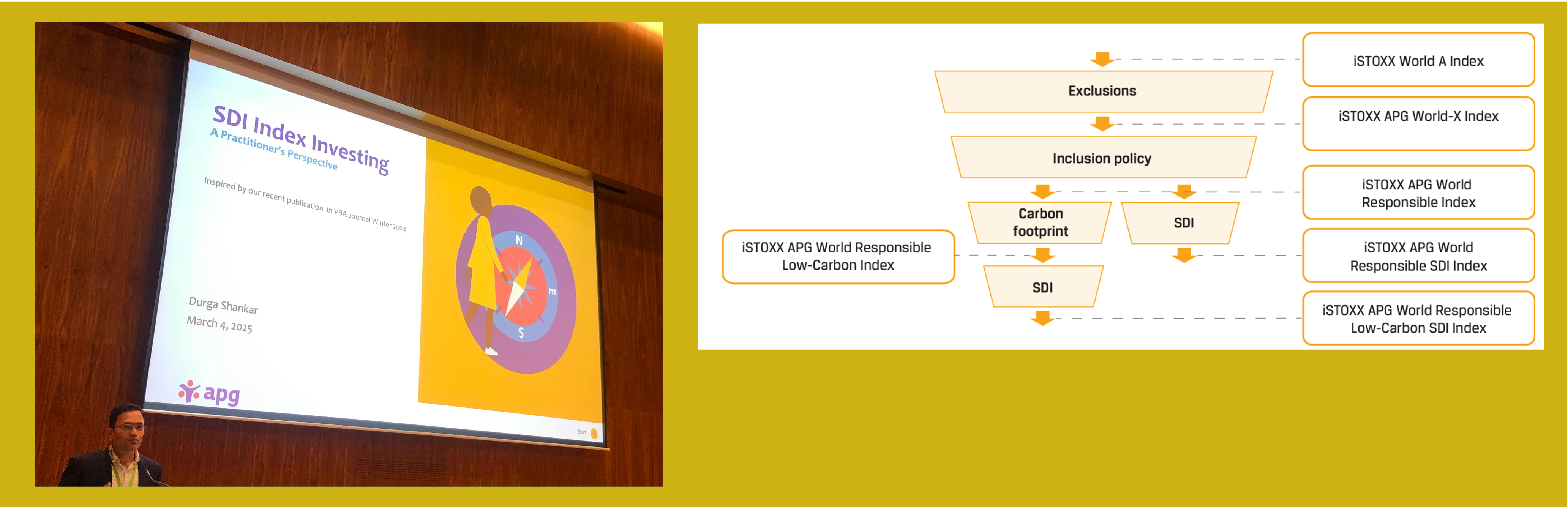
SDI Index Investing – A Practitioner’s Perspective
Durga Shankar is Senior Quant Researcher Index Solutions with APG, and shared APGs experiences with the construction of an equity index which has embedded the SDI AOP data. Interestingly, he shared results of research based on the four years the index has now been running. This provided the audience with a real-life application of the SDI Classification and the results of such a strategy, not by backtesting, but in reality. A key finding from the exercise was that the sustainable index did not show a significant deviation in performance when compared to a generic index over the time period covered. This is an important notion, particularly taking into account that the eventual index works with a substantially reduced universe versus the original generic benchmark. This prompted an interesting debate about the stability of the results and whether the circumstances of the past period are exemplary for the longer term evolution of the equity markets. Durga emphasized the importance of the appropriate construction of an index to arrive at a robust approach. The findings of APGs research have been published in the VBA journal. The work that APG have done demonstrates that there now is sufficient time series data to conduct in-sample research, which is a great support for those of us looking into the application of SDI data and wanting to understand what the consequences of these strategies are in reality.
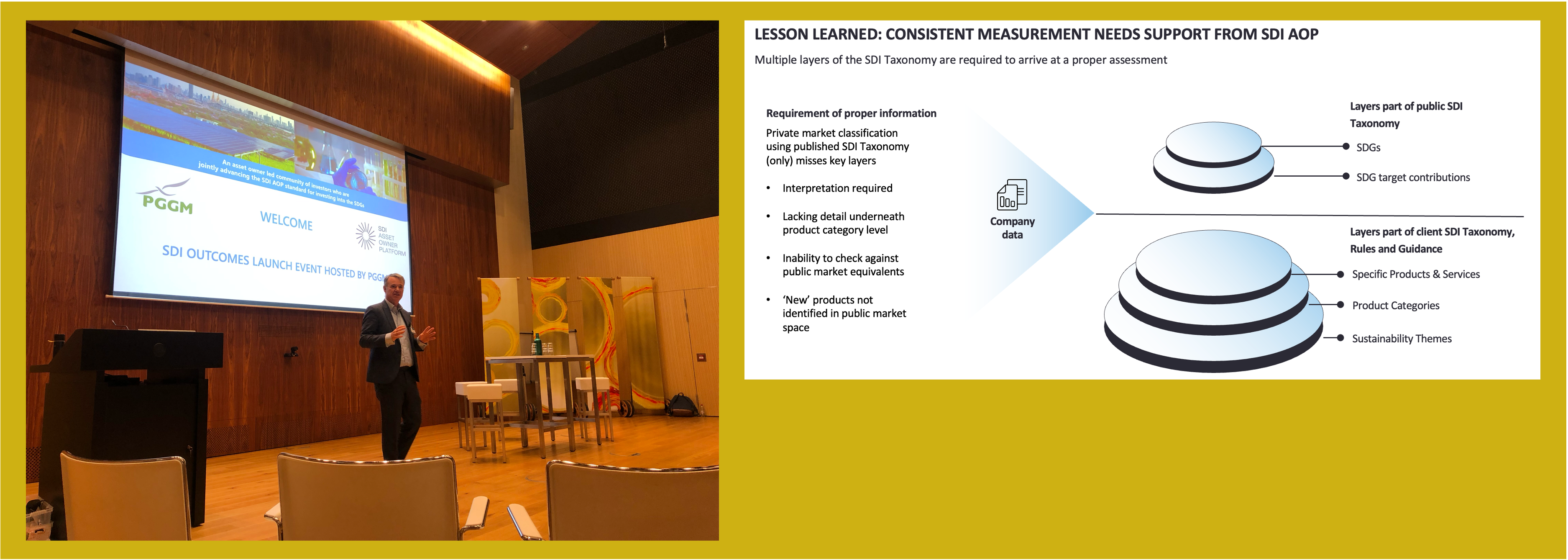
SDI Private Markets Classification
Shifting gears, Hans Op ‘t Veld moved from the technicalities of implementation in an index setting to the work that SDI AOP has done on private markets. He explained the origins and ongoing progress of the work, which was very much driven by the asset owner community wanting to achieve coverage of SDI across asset classes. Initially, SDI AOP started with offering tools for improved self-classification of private market entities. This was needed in view of the fact that the published SDI taxonomy is insufficient to consistently classify entities, as information on the underlying rules and guidance is not in the public domain. However, using the AI capabilities that SDI AOP leverages on the capital market side, work has been carried out to extend coverage to private markets as well. As a proof of concept, SDI AOP has classified close to 3,000 private companies included in private equity portfolios and the conclusions of this exercise were shared. From the exercise, it was found that the distribution of companies over the buckets of Non-SDI, Decisive-SDI and Majority-SDI companies was quite similar in private markets as is the case for public companies. However, the distribution over the SDGs contributed to was different. This is of interest to those investors that seek to focus on specific SDG contributions and/or to create a contribution profile across asset classes. The data solution is now being offered to clients on a bespoke basis as an add-on to the private markets subscription.
The presentation of the results led to various questions from the audience, which centered around the profile of public versus private market investment contributions. Particularly the ability to invest in certain solutions through earlier-phase companies and startups was debated. Furthermore, it was discussed whether any weight/allocation biases exist in the private markets versus what we have seen in capital markets. As the data set grows, it is likely there will be a better understanding of these elements.
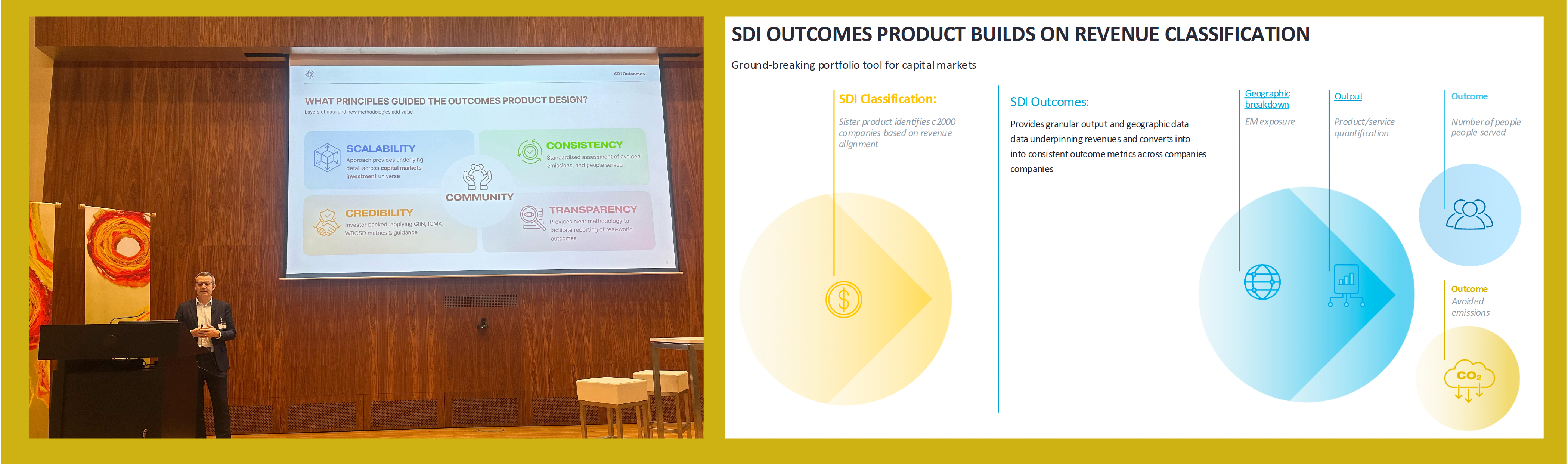
Launch SDI Outcomes – quantifying real world outputs and outcomes across a portfolio
Hans handed off to James Leaton (Research Director) and Stefan Gevaert (Research Analyst), who delivered the keynote session on SDI Outcomes. The launch of the SDI Outcomes product is the culmination of two years of work which was carried out building on previous work UBS and PGGM had done over the last decade. The purpose of the SDI Outcomes project is to provide information on the real world implications of investment in companies. In the development of the data, SDI AOP has engaged with the user community, expert groups and standard setters in selecting methodologies and determining a credible approach to measurement. James introduced the Outcomes dataset and shared the philosophy behind its “avoided emissions” and “people served” aggregated metrics. He explained the importance of data consistency and the challenges of considering various decarbonisation scenarios and value chain assumptions. He also indicated that by working on Outcomes, the granularity of the whole SDI family of products was increased in the process. These refinements include a more detailed revenue breakdown of activities such as renewables types, components, and installation, as well as extended geographic information, which were both needed to arrive at the level of exactness required for Outcomes data.
Stefan shared examples of how the various layers of data build on each other, and how company data is used and referenced to arrive at the outcomes data. He also showcased the transparency of this data, including links and clear confidence levels for the outputs underlying outcomes, and a detailed methodology on the sources behind the subsequent conversion to outcomes. This conversion is supported by academic evidence, as well as by standards that are considered market leading.
Based on the information, James illustrated how SDI Outcomes can be applied in different use cases, both talking about output data as an intermediate step as well as taking the outcomes data to answer specific questions investors have on the makeup of their portfolio or on specific companies.
The audience had an abundance of questions around SDI Outcomes. Various questions were asked about the challenges faced to arrive at a consistent methodology. James emphasized the relevance of pre-existing standards and the alignment with scientific data to substantiate findings and to arrive at credible conclusions. As this is a new dataset, a keyquestion was about its availability. The release of the dataset was simultaneous with the event and SDI Outcomes is now available as an add-on product to the SDI Classification product.
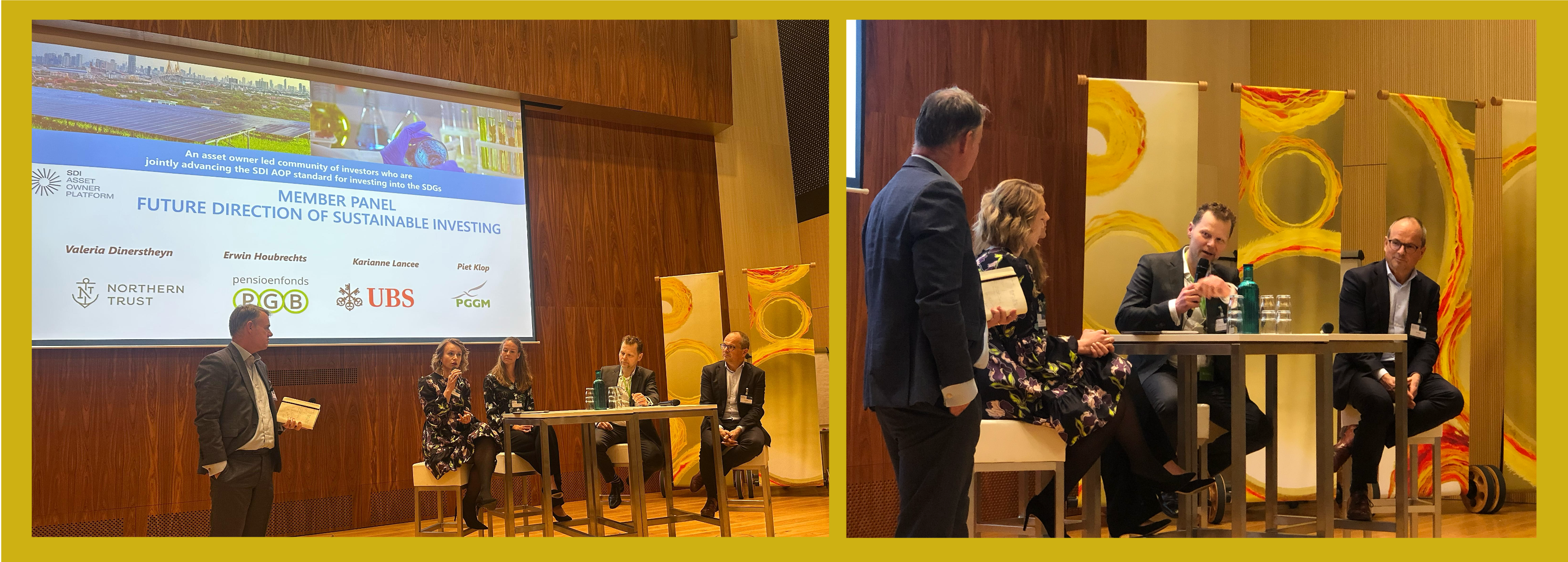
Discussion on the future direction of sustainable investing
After an animated debate about SDI Outcomes, Hans invited a panel of asset owners and asset managers to join the stage. The panelists Valeria Dinerstheyn (Northern Trust), Karianne Lancee (UBS), Erwin Houbrechts (PGB) and Piet Klop (PGGM) introduced themselves and their organisations. Each shared their perspective on how sustainability data is being leveraged to drive their investments. UBS has been on the journey for a long time, working with clients to get to outcomes data. Northern Trust is building out its capabilities in the space and is working with several datasets, including the SDI Innovation Outlook to assess investment opportunities. On the asset owner side, Erwin commented on the sustainability data infrastructure and the ability for asset owners and asset managers to align on data. He underlined the importance of data quality, which in the sustainability space is essential. Piet talked about the progression of PGGMs thinking on Outcomes and the reason why PGGM has spent and is spending time on these issues, particularly in consideration of the beneficiaries of the pension plan PFZW. A discussion ensued in which the panelists debated the necessity of having good quality data, the applicability of various datasets to inform decision making and the importance of reporting on progress in a consistent and robust manner. Certainly, the complexity of the space, perhaps exacerbated by regulation, has increased. This raises the question whether SDI AOP should be adding to its product suite to include even more related information of whether that should be left to others. Panelists agreed that first and foremost, the provision of high quality information on the growing universe across asset classes continues to be key and has the priority over venturing into other information. The ‘holy grail’ of sustainability information – should this exist – indeed is a standard that the current patchwork of information should converge into. SDI AOP certainly has a role to play in this, leveraging a growing community of subscribers that can guide the direction of innovation.
We owe a big thanks to PGGM for allowing us to use their auditorium and for catering the whole event. Furthermore, the speakers that contributed to the event through offering their knowledge and experiences resulted in an event that was not just enjoyable, but also very informative.