


SDI AOP strongly aligned with IIGCC Climate solutions guidance
The SDI taxonomy has been designed to focus on products and services which contribute to the sustainable development goals, so there is a natural fit for those under the climate theme. Our approach governed by the founding asset owners is developed by applying the same principles in the IIGCC guidance of Transparency, Standardisation and Robustness. We build transparency into our data and methodologies, and it is a central tenet of the WBCSD Avoided Emissions Guidance which we apply. The asset owners opened up the data to a wider community as a means of contributing to standardisation of investing in sustainability solutions. We include climate solutions that are identified in IPCC scenarios to ensure robustness, leaving investors to identify specific scenarios they want to align with.
Asset class applications
The asset owners involved in developing the methodologies have strategies and targets which apply across asset classes, which means the SDI approach is flexible enough to provide a framework across equity, fixed income and private markets. For example, SDI revenue percentages are one way that some investors set targets and report against their sustainable investment targets. We have also seen it applied in developing thematic indices and growth strategies – ultimately it is the investor philosophy and approach that determines the application.
IIGCC’s Climate Solutions Guidance propose the following 3-step approach to measuring exposure to and contribution to climate solutions, which SDI addresses as follows:
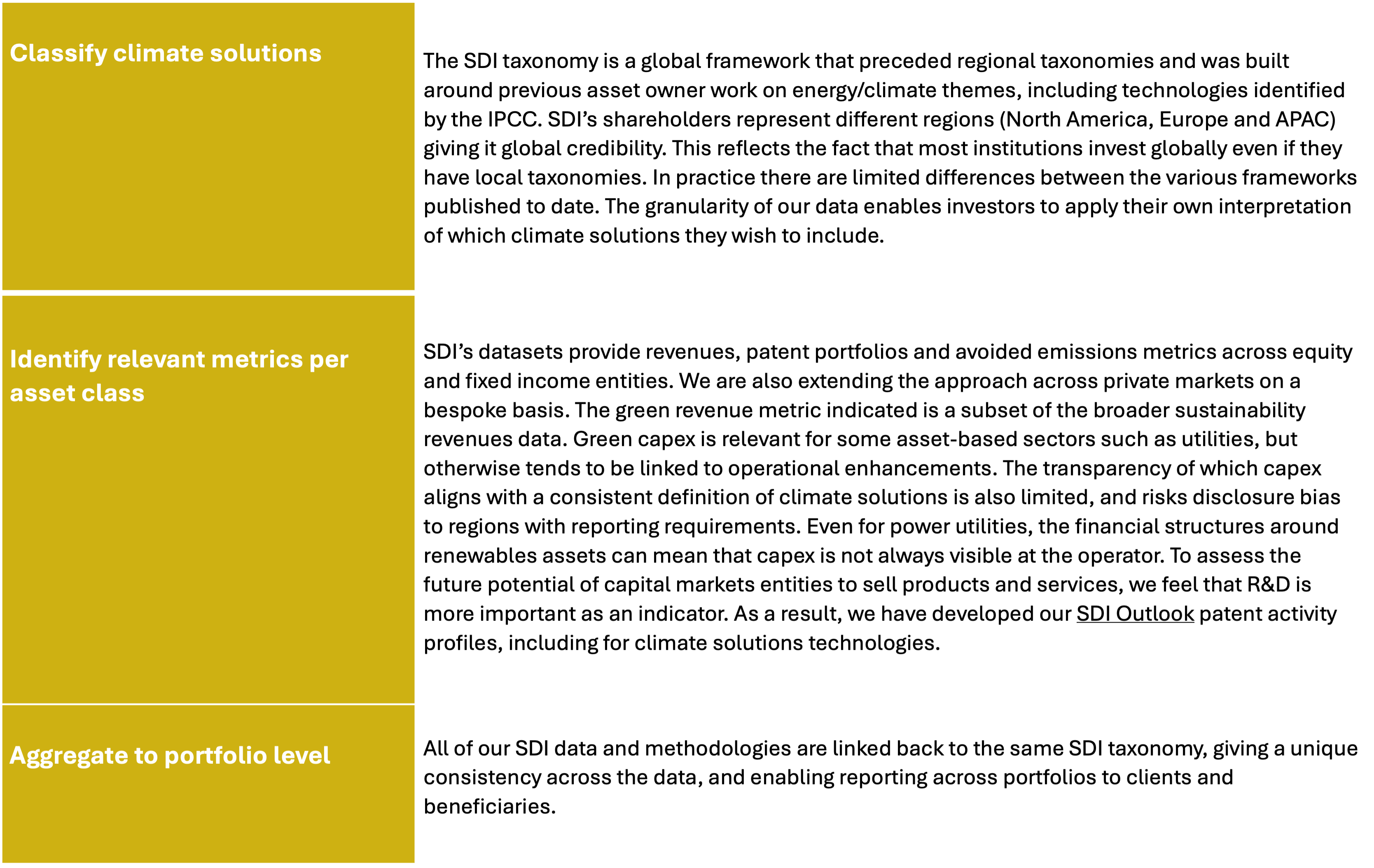
Operational & Production metrics
SDI captures the metrics indicated under the Outputs aspect of its SDI Outcomes product. Whilst SDI does not focus on operational metrics, the production aspects are covered, such as for utilities delivering renewable generation; vehicle and battery volumes from the electric vehicle value chain; critical minerals production; and recycling volumes. However as recommended by the GHG Protocol and WBCSD guidance, we agree that scope 1,2 & 3 emissions data should be kept separate from avoided emissions data. Whilst targets can be a useful indicator of ambition, there is also a risk that they can be changed at a later date, as has been seen with some oil & gas producers. The change in the SDI metrics over time can however be used as an indicator of transition progress at a company, however this starts to introduce a broader assessment that pure climate solutions exposure.
Avoided emissions metric
The avoided emissions methodology developed by SDI AOP has unique credibility from the involvement of some of the world’s largest asset owners. This also ensures a precautionary approach, as the asset owners are sensitive to risks of overclaiming avoided emissions. The process was led by James Leaton, our Research Director who is no stranger to producing innovative solutions, having developed a credit-relevant carbon transition assessment at Moody’s credit rating agency across high impact sectors, and being the lead author of Carbon Tracker’s ground-breaking research on carbon budgets and stranded assets. The approach built on previous efforts by PGGM and UBS and combines the best analysis from energy/climate institutions, industry, academics and analysts.
We endorse using PCAF’s approach to reporting portfolio exposure, and have set out our assumptions clearly in our methodology to deliver consistent data across our universe. For that reason, we do not rely on company estimates, as this would make data incomparable, and there is often insufficient information to be certain how the numbers are calculated. This consistency in how our avoided emissions numbers are produced also makes it possible to amalgamate data at a portfolio level, once users have taken into account the potential for multiple-counting along value-chains which we specifically address in our methodology.
Contrary to the IIGCC guidance, we do however believe that there is value in alignment of avoided emissions metrics with the revenue data we curate. The strong linkage between the SDI taxonomy, the SDI revenue data, and the related SDI Outcomes avoided emissions data only brings greater credibility to each layer. We consider the SDI Outcomes data as providing more context to the SDI revenue data,and indeed verifying that the revenues have been accurately attributed to a climate solution. If these metrics cannot be aligned then it raises a question as to why both are not included.
We concur with the IIGCC guidance that understanding the geography of where solutions are being deployed is an important aspect. This is why we have included geographic market data in our Outcomes product, which enables our clients to understand which companies have greater exposure to emerging markets. This can be particularly important to give more context as to where climate solutions can make the biggest contribution to achieving climate targets.
If you want to know more about how SDI-AOP’s approach can help you implement the IIGCC guidance please contact us at info@sdi-aop.org